


15th Club Golf GPS Rangefinder
Advantage Golf GPS Technology
I usually judge a golf app by what happens between arriving at the course and finishing the round. Does it help me choose a club without slowing me down? Can I record a score without turning every hole into an administrative task? Does the information remain useful when I am walking, playing with friends, or trying to remember what went wrong later? 15th Club Golf GPS is built around that complete on-course routine, combining GPS distances, course maps, scorekeeping, and shot tracking in one sports app.
After using it as a practical round companion, I see the appeal clearly. It is free to start, aimed at everyday golfers, and developed by Advantage Golf GPS Technology. The app has passed the early-experiment stage, with more than fifty thousand installs, although its average rating sits at 3.6 from roughly eight hundred ratings. That combination tells me to approach it as a useful tool with some rough edges rather than as a flawless replacement for dedicated golf hardware.
The app is available to an Everyone audience and was released on April 8, 2022. Its current version is 4.4.2, and optional purchases range from $4.99 to $79.99 per item. Those details matter because the basic entry point is approachable, while the cost of deeper use can vary depending on which extras a golfer decides to add.
From arriving at the course to finishing the round
The starting condition: a golfer with too much to remember
My normal problem before a round is not a lack of enthusiasm. It is the small collection of decisions that quickly piles up: finding the right course, estimating the next shot, remembering the score, and trying to learn anything from the round afterward. A paper card handles the score, but it does not help much with distance. A basic rangefinder gives me a number, but it does not preserve the context of the shot. A dedicated golf watch can be convenient, yet it adds another device to charge, wear, and learn.
15th Club Golf GPS takes the phone-first route. I can use the handset as the central place for the round rather than switching between a rangefinder, a scorecard, and a notes app. That is its strongest idea, and it is more important than any individual screen: the app tries to keep the information connected from preparation through review.
Related News

Why WhatsApp Messenger Still Makes Everyday Communication Feel Easy

Jurassic World: The Game Is the Better Dino Tycoon for Strategic Players

Threads in Real Life: Who Should Join, Lurk, or Leave

How SHEIN Turned Shopping Into an Endless Content Feed

How to Make Fortnite Feel Smarter on Mobile

Should You Switch to Microsoft Outlook on Mobile?
This approach suits a casual golfer who already carries a phone and wants more structure without immediately buying golf electronics. It also makes sense for someone who plays different courses and wants a repeatable process. I would be less enthusiastic about it for a player who dislikes looking at a phone during golf, needs the fastest possible distance reading, or expects the precision and instant visibility of a dedicated laser device.
Step one: preparing before the first tee
The first useful habit is to open the app before I am standing over the opening shot. That gives me time to orient myself, check the selected course, and decide how much information I actually want to use. A common mistake with feature-heavy golf tools is trying to operate every function immediately. I find the better workflow is to choose a simple goal: use the GPS for decisions, keep the scorecard current, and record shots only when doing so will teach me something.
That last point is important. Shot tracking can become valuable, but it can also become a distraction if I insist on documenting every movement with perfect detail. For a relaxed round, I might track only tee shots and approach shots. During a practice round, I can be more deliberate and use the feature to identify patterns. This makes the app feel less like a chore and more like a flexible record of the round.
Gallery
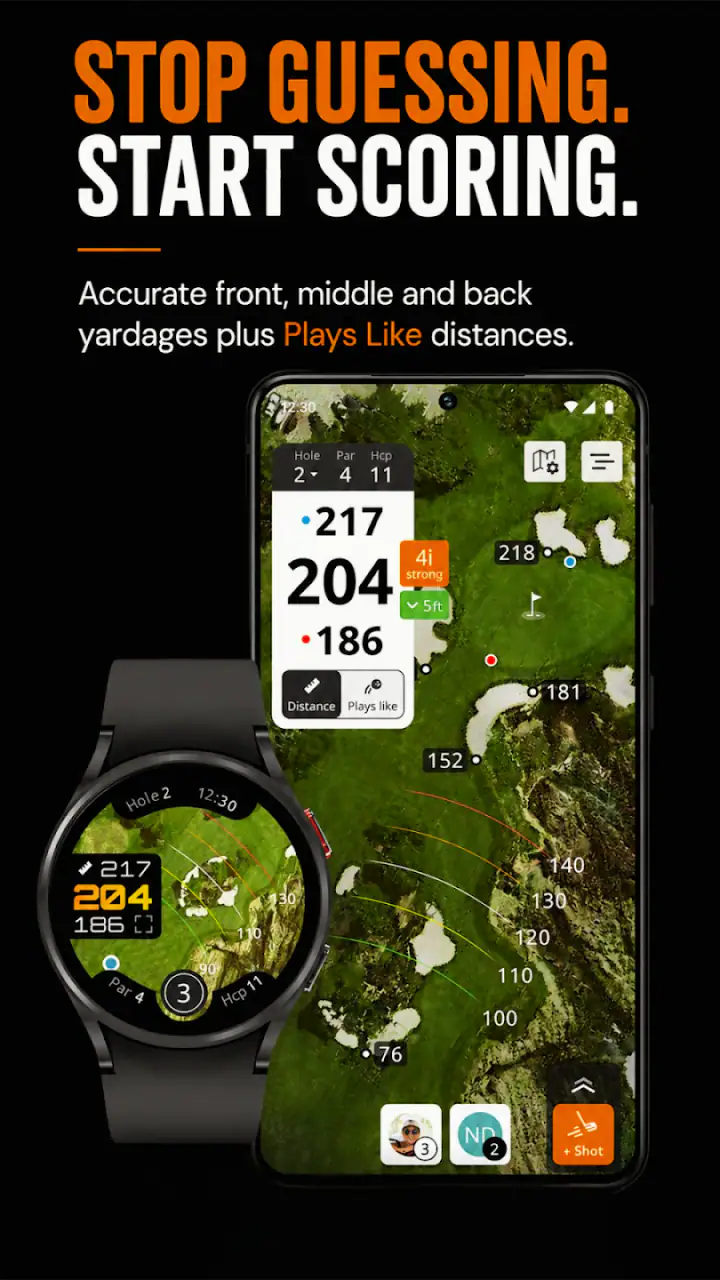
The course-map element is especially helpful before I hit. Instead of treating the hole as only a yardage problem, I can look at the layout and think about the next decision. A map encourages a better question than “How far is it?”: “Where do I want the ball to finish so that the following shot is easier?” That is a subtle advantage over a simple distance display.
Step two: making the distance decision
Once I reach a shot, the GPS rangefinder is the feature I expect to use most often. I want a quick reference for the distance and the shape of the hole, then I want to put the phone away and play. The app’s value is therefore not in showing me more information than I can process. It is in reducing the need to estimate blindly or walk back to a marker.
I would use the map as a planning layer and the distance reading as a confirmation layer. For example, on a hole where the landing area narrows beyond a visible bunker, the number alone may tempt me into an aggressive club choice. The map can make the safer landing area more obvious. This is one of the more useful ways to combine the app’s tools: GPS answers the immediate question, while the course view supports the larger strategy.
There is still a trade-off. A phone screen is not as effortless as glancing at a watch, and it may take a moment to wake, unlock, or hold in a readable position. In a fast-moving group, that friction matters. I would keep the app ready before reaching the ball and avoid treating it like a live dashboard that needs constant attention. The best experience comes when the phone supports the shot rather than becoming part of the shot routine.
Step three: handing the round over to the scorecard
After the shot decision, the next handoff is from planning to recordkeeping. The scorecard is where the app becomes more than a rangefinder. I can enter the result while the hole is still fresh, rather than relying on memory at the end. That is particularly useful when playing with friends, when several balls are in motion, or when a difficult hole has already taken most of my attention.
My practical advice is to update the score at a consistent moment. I prefer doing it after leaving the green, before moving fully to the next tee. Waiting until several holes have passed makes mistakes harder to correct, while entering it immediately after every shot would interrupt the round. A simple checkpoint after each completed hole creates a good balance between accuracy and pace.
The scorecard also gives the GPS features a useful destination. A distance reading that disappears after the shot is helpful once; a recorded score connected to the choices made during the hole can become useful later. Even if I do not analyze every round deeply, having a record makes it easier to remember whether a bad result came from poor club selection, an ambitious line, or a short-game mistake.
Step four: using shot tracking without slowing down
Shot tracking is the feature I would approach most selectively. Its benefit is not simply counting swings. The real benefit is creating a more honest picture of how a round unfolded. Golfers often remember the spectacular mistake and forget the quiet pattern: repeated misses to one side, short approaches that never reached the target area, or tee shots that left awkward second shots even when they stayed in play.
A useful workflow is to track shots during a focused practice round, then use the scorecard more lightly during a social round. That division protects the fun of playing with others while still giving the tracking feature a meaningful job. It also prevents the common trap of collecting information that I never review.
Another practical use is selective comparison. I might track only one club category for a few rounds, such as tee shots, instead of attempting a complete statistical record. That produces a narrower but more manageable question: are my drives creating playable next shots? If the answer is no, the map and distance tools can then help me test a different strategy on the next visit.
The handoffs that determine whether the app feels smooth
The most important handoffs are not between screens; they are between moments of attention. Before the shot, I am planning. During the shot, I need to stop operating the app. After the hole, I am recording. A good experience depends on moving cleanly between those states.
For me, the app works best when I prepare the next hole while walking toward the tee, check the map and distance before addressing the ball, and postpone detailed tracking until the shot is complete. That sequence keeps the phone from competing with the actual game. It also makes the scorecard a natural closing step rather than another interruption.
Playing with another golfer creates a second kind of handoff. If one person is keeping the group’s score, the app may become a shared reference rather than a private notebook. If everyone is managing their own round, each player needs to avoid delaying the group. In either case, the tool is most considerate when used during existing pauses: while others are preparing, while walking, or after clearing the green.
This is where a phone app differs from a dedicated rangefinder. A laser usually has one job and can be faster for a golfer who wants a direct target distance. 15th Club Golf GPS offers a broader workflow, but that breadth means I have to manage the handoffs myself. The reward is a more complete record; the cost is a little more interaction.
A realistic round: turning information into a better decision
Imagine I am playing an unfamiliar course on a weekend morning. I reach a hole where the visible fairway appears generous, but the approach area looks less inviting. I open the course map before choosing a club and use the GPS view to understand the space in front of me. Rather than automatically selecting the longest option, I choose a club that leaves a comfortable next shot.
After the tee shot, I check the remaining distance and consider the target area instead of aiming only at the flag. I record the shot if I am using tracking for this practice round, then continue. After finishing the hole, I enter the score before the next tee. The entire process gives me three connected pieces of information: what the hole looked like, what decision I made, and what result I recorded.
That connection is more valuable than any single number. Later, if the hole produced a poor score, I can ask whether the problem was the original plan or the execution. A plain paper card would preserve the score but not the decision context. A basic distance tool would help with the immediate shot but not the round’s story. This is the clearest reason to choose the app over simpler alternatives.
What the result is good for afterward
The immediate result is a more organized round. I spend less time guessing distances, I have a digital scorecard instead of a paper card that can be misplaced, and I can use shot tracking when I want a closer look at my play. The app is not a golf coach in my hands, but it can make my own observations more reliable.
The longer-term result depends on whether I review what I recorded. If I only use the GPS and enter scores, I get convenience. If I consistently track a specific part of my game, I get a basis for changing strategy. The important distinction is that the app can support improvement, but it does not automatically create improvement. I still need to notice patterns and make sensible adjustments.
I also appreciate that the app can fit different levels of commitment. A beginner can treat it as a digital guide for distances and scoring. An experienced player can use the map to plan safer lines and tracking to examine decisions. That flexibility is more convincing to me than a rigid system that assumes every golfer wants the same amount of analysis.
Where the flow breaks
The first weak point is phone dependence. If I am trying to keep the round moving, handling a phone can feel slower than looking at a watch or using a dedicated rangefinder. Screen visibility, battery planning, and the general inconvenience of carrying a device all remain part of the experience. The app cannot remove those physical limitations.
The second issue is attention. GPS, maps, scores, and shot tracking are useful precisely because they cover several jobs, but that also creates more opportunities to overuse them. A golfer who records every detail may spend too much time operating the app and too little time reading the course. I recommend deciding in advance whether the round is mainly for playing, planning, or practice analysis.
The third consideration is cost over time. The app itself is free, which makes it easy to try, but optional purchases are listed from $4.99 to $79.99 per item. I would not assume that every golfer needs the most expensive option. The sensible approach is to begin with the workflow that matters most—distance and scoring, for example—and only pay for additional value if the app becomes a regular part of your golf routine.
The rating of 3.6 also sets a realistic expectation. I would not install this believing that every golfer will find the experience equally smooth. Some users will prefer a simpler app with fewer moving parts, while others will value having several golf functions together. The right choice depends on whether the convenience of consolidation outweighs the interaction required on the course.
Who should use it, and who should skip it
I think 15th Club Golf GPS is a good match for casual and improving golfers who want a free starting point, a course-oriented GPS view, digital scoring, and the option to track shots. It is especially suitable for someone who already uses a phone during golf and wants to turn scattered observations into a repeatable routine.
I would also recommend it to a golfer who plays unfamiliar courses and tends to make decisions from visual impressions alone. The map can encourage more thoughtful planning, particularly when the safest landing area is not the most obvious one. For a player working on course management, that may be more useful than simply chasing maximum distance.
I would skip it if my only requirement were the quickest possible target reading. In that situation, a dedicated rangefinder may be the better tool. I would also look elsewhere if I wanted a highly specialized training system, a watch-first experience, or a completely hands-off round. This app asks me to participate in the workflow, and that is both its strength and its limitation.
My final take on the complete workflow
15th Club Golf GPS succeeds when I use it as a quiet assistant: prepare with the map, confirm the distance, play without staring at the screen, then record the result at a natural pause. Its best quality is the way those stages connect. The app does not merely show a number; it can help link planning, execution, scoring, and later reflection.
It is not the perfect choice for every golfer. Phone handling can interrupt the rhythm, shot tracking requires discipline, and the optional purchase range means the free starting point may not be the end of the cost conversation. Still, I find the overall idea practical and easy to understand. For golfers who want one flexible phone-based companion instead of several separate tools, this is worth trying before buying dedicated hardware.
My recommendation is to begin with a simple test round. Use the GPS and scorecard first, keep shot tracking limited to one type of shot, and notice whether the app helps you make decisions faster or merely adds another task. If it improves your routine, expand how you use it. If you find yourself waiting on the phone or losing focus, a simpler distance tool will probably serve you better.
FAQs for 15th Club Golf GPS Rangefinder
What is 15th Club Golf GPS Rangefinder, and what does it do?
15th Club Golf GPS Rangefinder is a golf companion app designed to provide GPS distances on the course. It can help you estimate yardage to the front, middle, and back of the green, while also displaying distances to relevant hazards or course targets when available. It is intended to support club selection and course strategy, although golfers should still consider elevation, wind, lie, and local course conditions.
Does 15th Club Golf GPS Rangefinder work on every golf course?
The app relies on its course database and GPS data, so coverage can vary depending on the course and region. Popular courses are more likely to be available, but smaller, newly built, or recently modified facilities may have incomplete information or may not appear immediately. Before starting a round, search for your course and confirm that the layout and hole information look correct rather than assuming coverage is guaranteed.
Does 15th Club Golf GPS Rangefinder require an internet connection?
An internet connection may be needed to download the app, sign in, update course information, or load a course for the first time. GPS positioning itself can generally work outdoors without mobile data, but offline behavior depends on whether the required course data has been downloaded or cached in advance. For reliable use, open the app before your round and prepare the course while connected to Wi-Fi or mobile data.
Is 15th Club Golf GPS Rangefinder accurate enough to replace a laser rangefinder?
The app can provide useful distance estimates, but GPS readings should be treated as a practical guide rather than a laboratory-precise measurement. Accuracy may be influenced by satellite reception, phone placement, course mapping, trees, buildings, and the quality of the available data. It is convenient for checking general yardages, while golfers who need exact pin measurements may still prefer a laser rangefinder or course-marked references.
Does using 15th Club Golf GPS Rangefinder drain the phone battery?
Like most golf GPS applications, 15th Club Golf GPS Rangefinder can use noticeable battery power because it keeps the screen active and regularly accesses location services during a round. Battery consumption varies by phone, brightness, signal strength, and how long you play. Starting with a full charge, lowering screen brightness, closing unnecessary apps, and carrying a power bank can help prevent the phone from running out before the final hole.
Pros
- Accurate GPS distances help with club selection on unfamiliar courses.
- Shot tracking makes it easier to review performance after each round.
- The interface is clean and quick to use while walking between shots.
- Course maps provide useful visual context for hazards and greens.
- Works well for golfers who want data without carrying a separate rangefinder.
Cons
- Some advanced statistics may require a paid subscription.
- GPS accuracy can vary near trees
- buildings
- or poor signal areas.
- Continuous location tracking may noticeably reduce battery life.
- The large course database may not cover every smaller or private course.
- New users may need time to understand all tracking and analysis features.


